
From Australia to Brazil – Growing a connection through Sport and Exercise Medicine
After travelling to Australia from his home in Brazil on Team Doctor duties in 2023, Dr Paulo Szeles experienced a care for safety in sport, of athletes and environments that left a mark.
It created a connection to the possibilities of learning more about sport and exercise medicine care in Australia, after working in the field for 20 years.
In 2025, Paulo returned to Australia with is family, completing a six-month research placement at the University of Sunshine Coast for his PhD. At that time, he joined the Australasian College and Sport and Exercise Physicians as an Associate Member and has continued to stay connected since returning home in March.
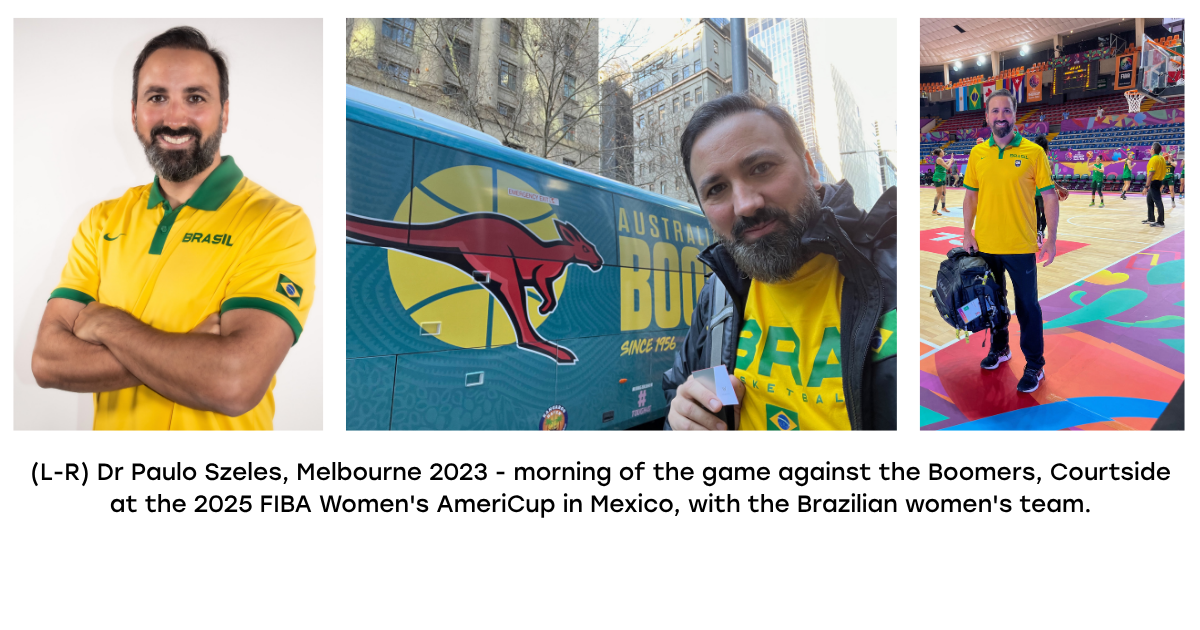
Dr Szeles holds specialist physician status in Brazil, registered with the Federal Council of Medicine as an RQE, (similar to a specialist registration in Australia) in both sport and exercise medicine and orthopaedics.
He is the currently deputy head of the UNIFESP (Federal University of Sao Paulo) sport and exercise medicine residency programme, which he headed from 2016 until 2025. His career has seen him spend 13 years with the Brazilian National Basketball team, and work at many international tournaments including the Rio 2016 Olympic Games and at the 2014 FIFA World Cup in Brazil.
We caught up with him while travelling with the Brazilian National Basketball team at the recent FIBA 2026 Women's Olympic Pre-Qualifying Tournament, in Guadalajara, to talk about his experience with the College, his growing connection to Australia and his career.
What has been your experience as an Associate member of the College?
As an associate member, most of my engagement has been through the SEM Academy, with eight modules completed so far, from the foundations through to biomechanics. I am working through the MOST course pre-learning now, ahead of the face-to-face days in Brisbane in October.
I also help run a sport and exercise medicine training programme in São Paulo, so I tend to look at how education is put together, not only at the content. The Academy is well organised, a large library covering the whole of the specialty and easy to move around in. The modules are built for someone who works: the right length, and you can stop and pick them up again without losing the thread. That matters when you are fitting study around a clinic list, or into whatever time a tournament week leaves you. The teaching comes from people who clearly know the field, and it is properly supported: cases, tables, video, references you can follow up.
I belong to several societies and I have sat through a great deal of continuing education. This is the first platform where I have gone back to review a module rather than simply tick it off.
Why have you chosen to stay connected with the College after returning home?
Leaving the country did not seem like a reason to leave the College. I had not realised, while I was there, how much of it works from anywhere. Almost everything is online, and the live sessions suit me from here. An evening in Australia is early morning in São Paulo, so I can follow them before the day starts.
There is a second reason. Sport and exercise medicine is a small specialty, but it covers a very wide field. The Academy holds all of it in one place, from the foundations through to the specific, and that is not an easy thing to build.
And I liked it there. Six months in Australia was a good time for my family and for me, and this is the part of it that came home with me.
What impressed you most about sport and exercise medicine in Australia? Did you experience any sport locally?
What impressed me most was how seriously the whole thing is set up.
I am speaking as someone who has spent twenty years working events, so this is the first thing I notice. I first came to Australia in 2023, with the Brazilian men's basketball team, for a friendly tournament before the World Cup. We trained at the Melbourne Sports Centres, which is an impressive thing to walk into. It is a very large facility, with athletes from several different sports sharing it, and everything working as it should.
Then we played the Boomers at Rod Laver Arena, where the medical set-up was excellent: the rooms, the emergency provision, the access, the way everything was positioned. When a venue is organised like that, you can concentrate on the athlete instead of on logistics. That is not luck. Someone thought about the doctor when they designed it. Perhaps I should not say who won that game, but it is easy to look up.
The same care runs a long way down. My two boys were at a school on the Sunshine Coast with a full-time football programme, and the standard around it did not drop just because it was school sport. That tells you more about a country's relationship with sport than any elite programme does.
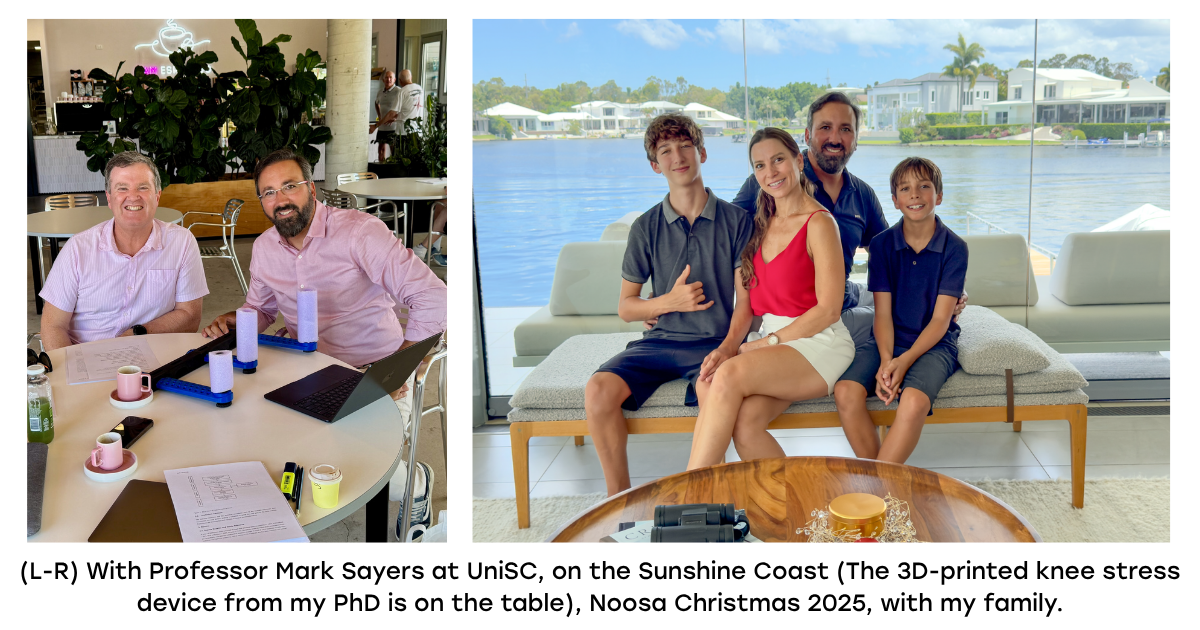
As for sport locally, we lived in Noosa, so we surfed most weekends (badly, in my case), I ran, and I watched a great deal of junior football and athletics.
What were you working on during your research placement at UniSC?
The question behind my PhD is a very practical one: how do you properly assess a knee ligament injury when you are nowhere near a hospital?
The work centres on a portable, 3D-printed device that applies a standardised valgus load to the knee, so the joint can be imaged under stress (with ultrasound at the bedside or pitch-side, or radiographically in the clinic). Applying that load by hand is notoriously operator-dependent, and the device is designed to make that reproducible. I had designed it in Brazil, and brought it with me.
Standardising the measurement is what gives the device its value, and getting there takes biomechanics as much as clinical judgement. That is what I went to the Sunshine Coast for. Professor Mark Sayers, a sports biomechanist, hosted me at UniSC, and he brought exactly the scrutiny the protocol needed: how the load is applied, how the joint is held, what precisely is being measured. We refined both the device and the protocol, and the analysis and the write-up followed from there.
What have you taken from your Australian experience back to your work in Brazil?
Two things came back with me.
The first I expected. Australian universities have their reputation for a reason, and UniSC was exactly that, so the research side went the way I hoped it would. The stress ultrasound technique I refined there is now part of what I teach our residents in São Paulo, and it will be in the final publications from my PhD.
The second I did not go looking for. In November we watched the Noosa Triathlon. Professionals were racing the same course as complete beginners, and there was a children's race in the same festival. Teenagers and athletes decades older were all out on the same morning. I had not seen anything like it, and it is what I talk about most at home. There is even a running shoe named after that race. I bought a pair, naturally, and I still run in them.
What are you looking forward to most about attending the conference this year?
What I am looking forward to most is seeing different perspectives and learning things I do not come across at home. Australian sport and exercise medicine deals with sports we simply do not have (netball, Australian Rules football, cricket) and with the injury patterns that come with them. Netball interests me in particular, because the loads on the knee look very much like the ones I see in basketball.
I will also be presenting twice. The poster is from my PhD, so it comes directly out of the months I spent at UniSC. The oral presentation is earlier work, from my master's, on CrossFit. I want to hear the feedback of colleagues who work in a different system.
Before the conference I will do the MOST course. For a doctor who works on the field of play it is important to stay current with trauma care, and this is the College's own course, so I am curious to see how they teach it and where our approaches differ. I would also like to see what is being done in musculoskeletal ultrasound, which is the area of my research.
What would you say to other doctors considering membership?
To a doctor outside Australia and New Zealand, my first point would be that most of us do not know this exists. I did not, until I was there. The material is very good.
Look at the range. In the same library there are modules on combat sports, on ultrasound guided injections, on menopause, on organisational and ethical issues in team care, and on climate change in healthcare. Ultrasound guided injections is a large part of my week, and it is the module I most want to do next.
I did the Aboriginal Health and Cultural Safety module while we were living there. I would not pretend it is essential for a doctor who will never work in Australia, but it taught me something about how a health system thinks about the people it serves, and that is a question in every country.
It was written for Australian and New Zealand trainees, but there is very little in it that only makes sense in Australia. That is why I would recommend it to a colleague in another country.
Story by Ryan Mobilia, ACSEP Communications and Engagement Advisor (17 September 2026)
Become an Associate Member of the Australasian College of Sport and Exercise Physicians
If you're a medical practitioner with an interest in Sport and Exercise Medicine (SEM) or considering a future career in SEM, Associate Membership can support your journey through access to SEM education, course discounts and networking opportunities.
For more information including eligibility requirements, fees and member benefits find out more and apply here now: Associate Members - Australasian College of Sport and Exercise Physicians