
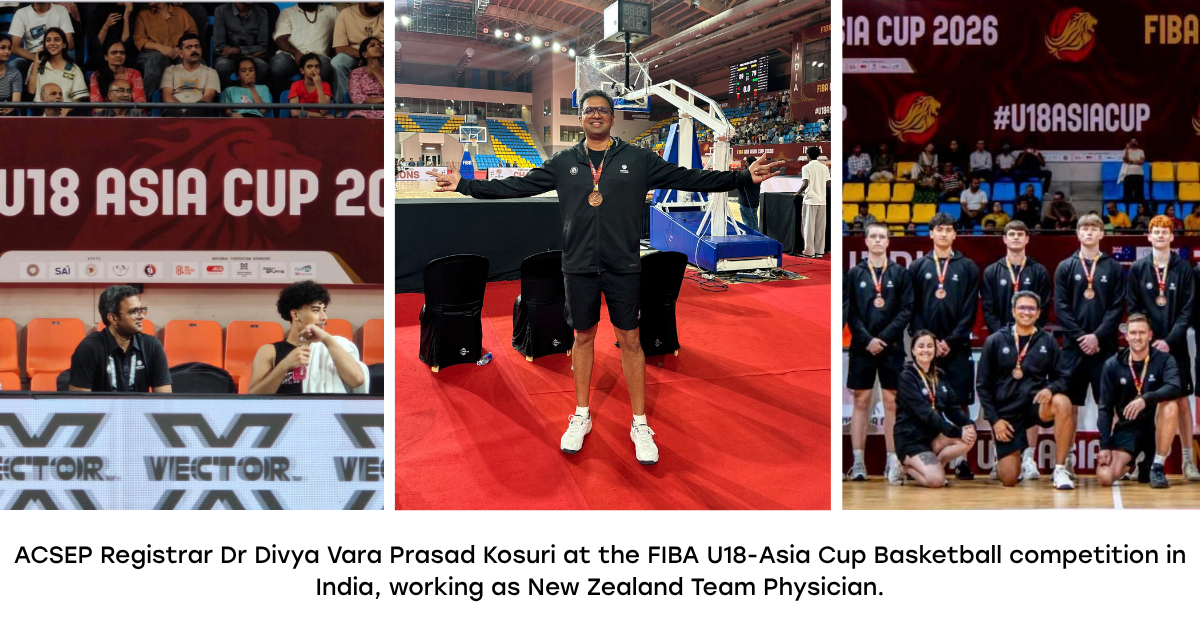
ACSEP Registrar Dr Divya Vara Prasad Kosuri recently completed a successful campaign, touring and working at the FIBA U18-Asia Cup Basketball competition in India, as New Zealand Team Physician.
We spoke to Divya after the experience, to give us an insight into the planning, preparation, and day-to-day experience of travelling with a team overseas. We're grateful to Divya for providing such great insight, and advice for those navigating travel with a team in the future.
Each time travelling with a team there will be different things to navigate, unique to that tour. For Divya, this experience was helped due to his history in India.
"Having grown up and worked in India, as well as speaking a few of the local languages, I was able to navigate the local medical system smoothly, which made the whole experience both seamless and rewarding."
Find out more in the Q&A below.
Can you tell us a bit about your work?
I am based in Hamilton, New Zealand and beyond my work with basketball, I maintain an active and ongoing involvement across a wide range of elite sports teams and major international events:
-
Cricket (BLACKCAPS): I work in an ongoing capacity as Team Doctor and Match Day Doctor for the BLACKCAPS (NZ Men’s Cricket Team), having provided medical coverage across Test, ODI, and T20 series. I am looking forward to looking after the BLACKCAPS again next month during the Hamilton leg of the India tour of New Zealand.
-
Rugby Union: I am part of the New Zealand Rugby medical team, providing match day coverage for various All Blacks and Black Ferns Test matches. I also serve as match day medical staff for the Chiefs in both Super Rugby Pacific and Super Rugby Aupiki, alongside my roles as Team Physician for Hamilton Marist Rugby and previously the Waikato Women’s U18 team.
-
Hockey & Netball: I worked as Team Doctor / Match Day Doctor for the New Zealand Men's Hockey team (Black Sticks) and provide medical coverage for ANZ Premiership Netball.
-
Endurance Medicine & Medical Leadership: I have served as Medical Director for the Waitomo Trail Run and the NZ North Island School Track Cycling Championships. Additionally, I have been the Clinical Lead for many years at endurance events like the Tarawera Ultramarathon, served as Clinical Lead Ironman Taupō, and provided medical support at Crankworx Rotorua mountain biking.
Working across such diverse environments—from high-collision contact sports and court sports to multi-day ultra-endurance events—has given me a broad clinical perspective and a deep appreciation for the unique medical demands of each discipline.
Tell us about this opportunity to join Basketball New Zealand in India? What did a typical day look like?
I first learned about this opportunity through an advertisement posted on the New Zealand ACSEP Registrars WhatsApp group. After applying and completing an interview process with Basketball New Zealand, I was thrilled to be selected as Team Physician for the NZ U18 Basketball team (Junior Tall Blacks) for the FIBA U18 Asia Cup in Ahmedabad, India—where the team ultimately secured a Bronze Medal!
A typical day on tour was full-on, highly structured, and dynamic from dawn until late evening:
- 05:30 – 06:00 AM: Wake-up, administrative prep, and organizing the schedule based on overnight player wellness updates.
- 06:00 – 07:30 AM: Early medical rounds, visiting rooms to manage acute illnesses and closely monitor sick players isolating with infectious conditions.
- 07:30 – 08:30 AM: Team breakfast
- 08:30 – 09:00 AM: Morning staff meeting with coaches and manager to review player availability, daily logistics and team planning for the game.
- 09:00 – 11:00 AM: Travel to the venue for team practice and provide court-side medical coverage.
- 11:00 AM – 12:00 PM: Post-practice wind-down and with players having optional gym or pool-based recovery sessions.
- 12:00 – 01:00 PM: Team lunch.
- 01:00 – 03:00 PM: Injury assessment, triage, and rehabilitation clinic conducted alongside the team physiotherapist.
- 03:30 – 07:00 PM: Travel to the arena for match play, providing pitch-side/court-side acute medical coverage, and returning post-game.
- 07:30 – 08:30 PM: Team dinner.
- 09:30 – 10:00 PM: Evening team debrief and planning session before wrapping up for the night.
Any advice for Registrars looking to travel overseas with a team that might help them? Particularly those for whom it might be a first time?
Proactive medical intelligence & local networks: Prior to departing, I established connections with the medical fraternity in the destination city and consulted with a local infectious disease expert. Gathering ground data on the current incidence and prevalence of infectious diseases allowed me to design an appropriate pre-travel vaccination and prophylaxis schedule, alongside tour precautions and medication planning. Furthermore, connecting early with the Venue Medical Officer for the event meant that whenever local support was needed on the ground, I had an established contact who could assist immediately.
Build a strong general medicine foundation: Sports medicine is my second fellowship—I originally trained as a General Practitioner, and I continue to work in GP practice to keep my general medical knowledge sharp and up to date. On tour, a massive portion of what you manage isn't musculoskeletal—it's acute medical conditions, infections, and general illnesses. I highly encourage registrars coming directly into sports medicine to work at least half a day to a full day a week in general practice for at least a year prior to touring. It dramatically boosts your confidence and decision-making when managing complex medical issues in foreign environments.
Early recognition keeps the team performing: On this tour, we had a couple of complex medical situations arise with key players and support staff who were vital to the team's success. Having that solid GP background allowed me to recognize what was going on early, initiate prompt, appropriate care, and keep everyone healthy and available when the team needed them most. Those timely medical interventions played a crucial role in helping the team stand on the podium—and built a deep bond of trust that remains strong today.
Cultural and Linguistic Nuance: Growing up in India and understanding up to five languages was an invaluable asset on this tour. Clear, empathetic communication under pressure makes all the difference when dealing with local healthcare systems, foreign event organizers, or anxious athletes.
Anything else you’d like to say about the experience?
Touring with the Junior Tall Blacks and coming home with a FIBA Asia Cup Bronze Medal was an incredibly rewarding experience. Bringing together my background in General practice and Sports Medicine to support elite young athletes on the world stage made it particularly special.
We were exceptionally well catered for by our hosts, who prepared special dishes for us on request to give us an authentic taste of the local cuisine—it was so good that some of the support staff even put on a few extra kgs by the end of the tour! It wasn't all work and clinical coverage either—we managed to sneak in a couple of local tours on our days off, which allowed the team and staff to unwind, experience the culture, and bond outside of the court environment!
Touring tests your adaptability, clinical decision-making, and teamwork in real-time. I strongly encourage any registrar considering touring opportunities to step out of their comfort zone and embrace the challenge—it is one of the most fulfilling aspects of our specialty!
15 October 2026